It Is Not the Mirror. It Is Where the Lights Are.

Quick Answer: Most gyms use ceiling-mounted downlights. Light falling straight down carves shadows under the eyes, collarbones, and abdomen, and flattens everything facing forward. Move two steps so light hits you from the side or front and the same body in the same mirror reads completely differently.
You take the photo, hate it, take another one four feet to the left, and suddenly it is fine. The mirror did not change in four feet. The angle of the light did, and light is doing about 80 percent of the work in that image.
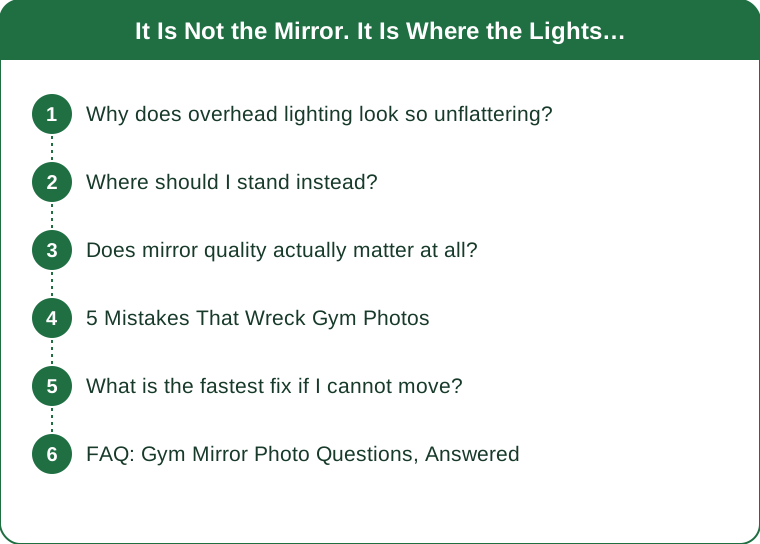
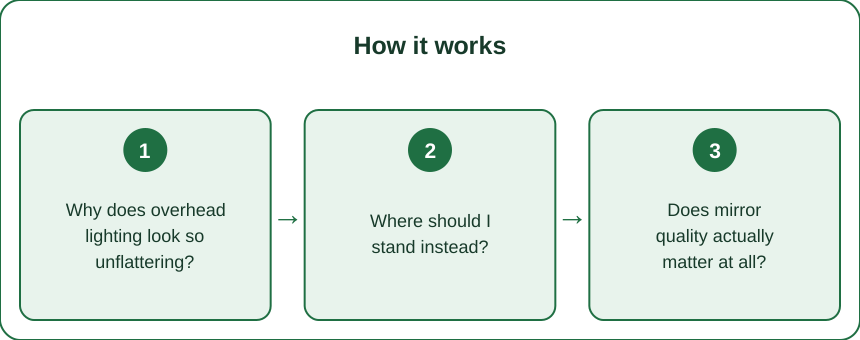
Why does overhead lighting look so unflattering?
Downlight creates what photographers call butterfly or worse, top-light. It puts shadow in every recess: under the brow, under the cheekbones, under the bust, across the abdomen.
Those shadows read as depth. Depth in the wrong places reads as hollows, lines, and unevenness. It is the same reason a flashlight held above your face looks unsettling.
Gyms use downlight because it is efficient and evenly covers floor space. Nothing about that choice is aimed at how people photograph. In a room lit entirely from the ceiling, there is no fill light bouncing back up to soften the shadows, and the effect compounds.
Where should I stand instead?
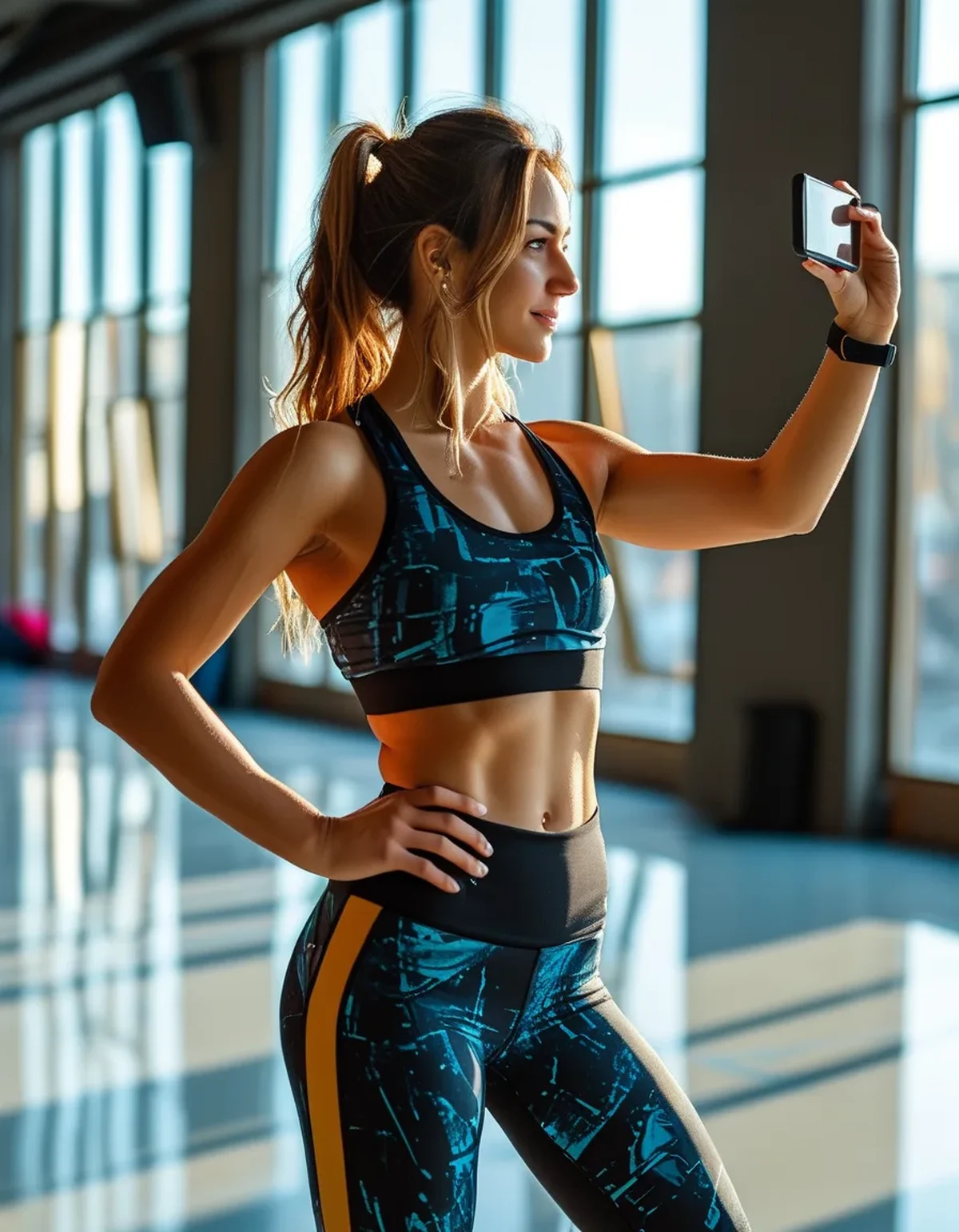
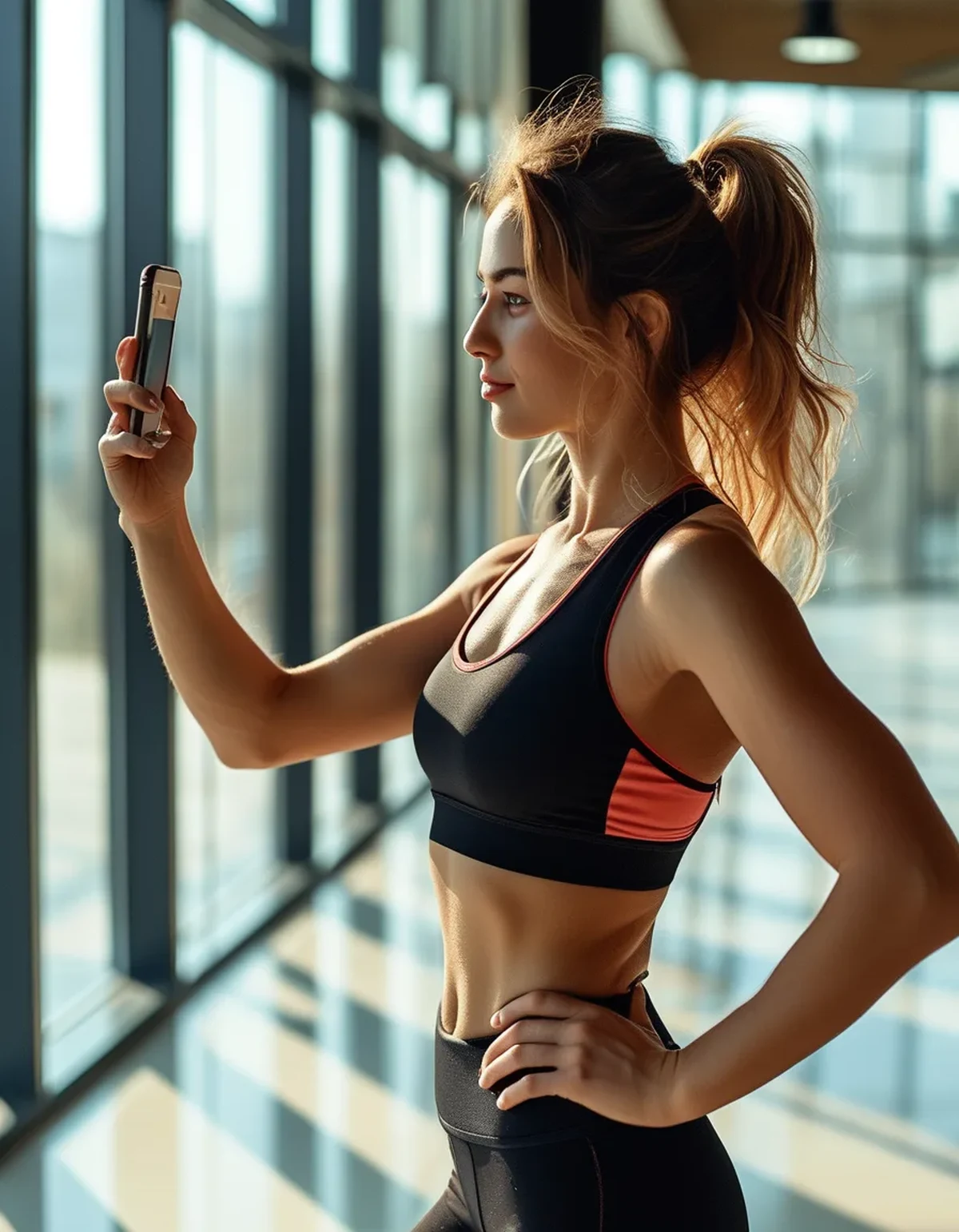
Find a window or a wall-mounted light and put it in front of you or at roughly 45 degrees to one side. Front light fills shadows. Side light at 45 degrees defines shape without carving.
In practice that usually means turning around. Most people default to the mirror wall furthest from windows because that is where the free floor space is.
A quick test: hold your hand out flat, palm up, at chest height. If the top of your hand is bright and your palm is dark, you are under top light. Move until your palm gets light too.
Does mirror quality actually matter at all?
Some, but far less than lighting. Cheap gym mirrors are typically 4-6mm float glass, which can have slight waviness from mounting pressure or thermal flex.
That produces localized distortion, usually visible as a subtle bend in a straight vertical line. Stand next to a door frame reflected in the mirror and look at whether it stays straight.
If the line bends, the mirror is genuinely distorting and moving a few feet along the wall will fix it. If the line is straight, the mirror is fine and the problem is above your head.
5 Mistakes That Wreck Gym Photos
1. Shooting from below. Holding the phone at waist height and tilting up shortens the body and widens everything closest to the lens. Shoot from chest height or slightly above.
2. Standing too close to the mirror. Phone lenses are wide-angle, and wide-angle distortion is worst near the frame edges and at close range. Step back three feet.
3. Using the front camera. The selfie camera on most phones is lower resolution with a wider lens. Turning around and using the rear camera into the mirror is a real upgrade.
4. Shooting directly under a light fixture. Look up before you shoot. If a fixture is right above you, move.
5. Wearing high-shine fabric under downlight. Glossy performance fabrics throw specular highlights straight back at the ceiling light, creating bright streaks that read as bulk. Matte fabrics photograph considerably more forgivingly, and this is the one almost nobody guesses.
What is the fastest fix if I cannot move?
Change the camera angle instead of the lighting.
- Raise the phone to eye level or slightly above
- Step back so you fill about two-thirds of the frame, not all of it
- Turn your body 20-30 degrees off square to the mirror
- Tap to focus on your torso so the phone meters for you, not the bright ceiling
That last one matters more than it sounds. Phones default to averaging the whole scene, and a bright ceiling fixture in frame will cause the camera to darken you specifically. Tapping your torso forces the exposure back where it belongs.
FAQ: Gym Mirror Photo Questions, Answered
Why do I look better in the locker room mirror?
Locker rooms typically use wall-mounted lights at face height, which is close to ideal fill lighting. The gym floor uses ceiling light. Different rooms, different physics.
Is one gym mirror more accurate than another?
Accuracy is about flatness, not flattery. A flat mirror in bad light is accurate and unflattering at the same time.
Does the phone slim or widen me?
Both, depending on distance. Close range widens what is nearest the lens. Three or more feet back with a slight zoom is the most proportionally honest setup you can get from a phone.
TL;DR:
- Ceiling downlight creates shadows in every recess, which is what makes gym photos harsh
- Front or 45-degree side light fixes it; check by holding your palm up
- Shoot from chest height or above, three feet back, with the rear camera
- Matte fabrics photograph better than shiny ones under overhead light
Next time you are about to delete a gym photo, walk toward the nearest window and take the same shot again. The comparison is usually startling enough that you stop blaming the mirror permanently.
Keep Reading
This article is for general informational and styling purposes only. Fit, sizing, and product availability may vary.