Why Checking the Mirror Mid-Set Changes Your Bar Path

Quick Answer: Your head position drives your spine and hip position through reflexive neck patterns, so turning to look at a mirror rotates and shifts the load path in the middle of a rep. On top of that, mirror feedback arrives too late to correct anything within a rep, since a squat takes two seconds and a corrective response takes longer than that. Mirrors are useful between sets and largely counterproductive during them. Video after the set gives you better information with none of the interference.
You look across to check whether your knees are tracking. In the process you rotate your head five degrees, drop one shoulder, and shift your weight toward the mirror side.
You have just introduced the exact problem you were checking for.

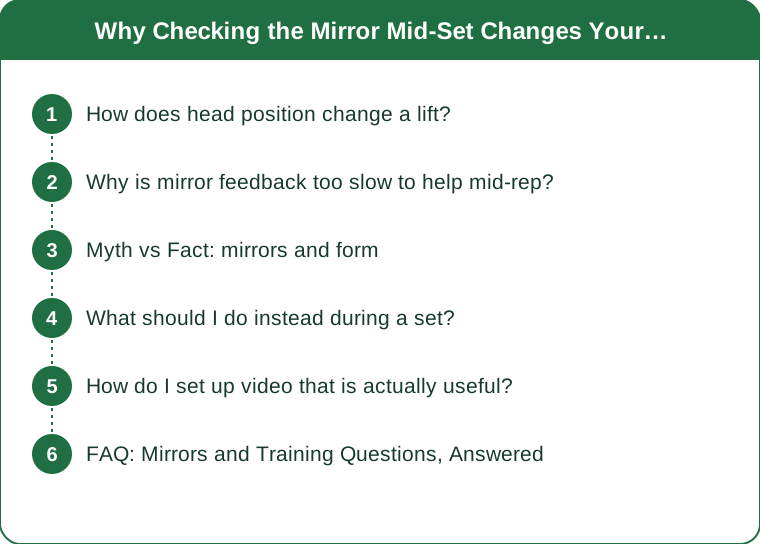
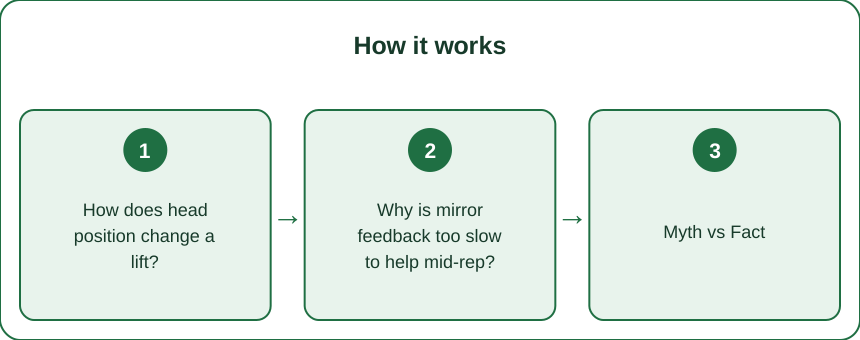
How does head position change a lift?
Through two well-established mechanisms.
Cervical reflexes. Neck position influences muscle tone throughout the body. Turning the head tends to increase extensor tone on the side you turn toward and flexor tone on the opposite side. It is subtle in a relaxed person and much less subtle under load.
Gaze drives posture. Where you look strongly influences where your torso goes. Look up and the chest tends to rise and the hips shoot back. Look down and the torso folds forward. Look sideways and the whole system rotates slightly to follow.
Under a loaded barbell, a small rotation at the top of the spine becomes a measurable asymmetry at the hip. You are not just observing the lift, you are steering it.
This matters most on bilateral lifts where symmetry is the point: squats, deadlifts, overhead press. It matters least on single-arm work where you are already asymmetric by design.
Why is mirror feedback too slow to help mid-rep?
Because of simple timing.
A competitive squat descends and ascends in roughly 1.5 to 3 seconds. Visual processing plus decision plus motor correction takes on the order of 200 to 500 milliseconds for a simple, practised response, and considerably longer for a complex postural adjustment you have to interpret first.
By the time you have seen your knee position, understood it, and generated a correction, the rep is largely over. The correction lands in the next rep at best, and often lands as a late, jerky adjustment that is worse than the original error.
There is also a perception problem. In a mirror you see a two-dimensional, laterally reversed, front-on view. Most of the things worth checking on a squat or deadlift are visible from the side, and the side is exactly the view a wall mirror cannot give you while you face it.
So what is the mirror actually good for?
Static setup checks, before the set. Bar position on the back, foot width, whether the shoulders are level. Those are all things a still image conveys well.
Myth vs Fact: mirrors and form
Myth: Watching yourself lift improves technique. Fact: Studies on motor learning consistently favour an external focus of attention, on the outcome or the object, over an internal focus on your own body. Mirror watching is close to the definition of an internal focus, and it tends to produce slower, less efficient movement.
Myth: Beginners need mirrors most. Fact: Beginners are the group most disrupted by them, because they have not yet built the internal sense of position that would let them use the visual feedback productively. They are also the group most likely to develop a dependency on external feedback, which then does not transfer.
Myth: No mirrors means no feedback. Fact: Video is better feedback in every respect except immediacy, and immediacy was never usable anyway. A phone on a bench recording from the side beats any mirror in the building.
Myth: Mirrors help you check depth. Fact: Front-on depth judgement is very unreliable. Depth is a side-view assessment, and even from the side people misjudge it consistently until they see footage.
Myth: Elite lifters use mirrors. Fact: Serious powerlifting and weightlifting gyms frequently have no mirrors in the lifting area at all. Coaching, video and proprioception replace them, and that is a deliberate choice rather than an aesthetic one.

What should I do instead during a set?
Pick one external cue and hold your gaze fixed.
- Fix your eyes on a point at roughly eye level, a few metres away, and keep them there for the whole set. A spot on the wall. Not the mirror, not the floor, not moving.
- Use one cue per set, not five. Something like push the floor away, or spread the floor, or bar over mid-foot. Multiple simultaneous cues degrade performance.
- Prefer outcome-focused cues over body-focused ones. Drive the bar toward the ceiling works better for most people than contract your glutes, and there is a reasonable body of motor learning research behind that.
- Let the set be the set. Assess afterwards, not during.
For the set itself, breathing and bracing deserve the attention you were giving the mirror. A consistent brace does more for bar path than any visual check.
What about the last rep of a hard set?
Especially then. Form degrades under fatigue and that is when a head turn is most destabilising. Fixed gaze, one cue, finish the rep.
How do I set up video that is actually useful?
Five minutes of setup that replaces the mirror entirely.
- Film from the side, at hip height, roughly three metres away. This single view shows bar path, hip and knee angles, depth and spinal position. The front view shows knee tracking and little else.
- Get the whole body plus the bar in frame, including the floor. Cropped feet make everything harder to judge.
- Record one working set per session, not every set. More footage than you will review is footage you will not review.
- Watch it between sets, once, at normal speed and once slowed. Look for one thing.
- Compare across weeks, not within a session. Same angle, same distance, same lift.
Draw the bar path if you want the clearest possible signal. Several free apps do this automatically, and a bar path line tells you more in one glance about a squat or a deadlift than an hour in front of a mirror.
And the honest note about home gyms: if you already have a mirror on the wall, you do not have to remove it. Just stop looking at it mid-rep. Use it before the set for setup and let the camera do the rest.
This is general information, not coaching or medical advice.
FAQ: Mirrors and Training Questions, Answered
Does this apply to machine exercises too?
Less. Machines constrain the movement path, so a head turn does much less damage. It still splits your attention.
What about mirrors for cardio or classes?
Different purpose entirely. In a group class the mirror is largely for following the instructor and for spatial awareness, both of which it does well.
Should I face away from the mirror to lift?
If the layout allows it, many people find it removes the temptation completely, which is the real benefit.
Is training without a mirror harder at first?
Yes, for a week or two, and that difficulty is the point. Proprioception improves when it has to, and it transfers to every environment. Mirror-dependent technique does not.
TL;DR:
- Turning to check the mirror rotates your head, which changes spinal and hip position under load. You alter the lift by observing it.
- Mirror feedback is too slow to correct within a rep and gives you a front view when most errors are visible from the side.
- Motor learning research favours an external focus, which mirror watching directly undermines.
- Use the mirror before the set for setup, fix your gaze on a static point during it, and use side-view video for actual feedback.
The mirror is not the enemy. Looking at it while the bar is moving is, and swapping that glance for a fixed gaze plus one recorded set is a free upgrade to every session.
Keep Reading
This article is for general informational and styling purposes only. Fit, sizing, and product availability may vary.