Where to Put a Mirror in a Home Gym and Why Position Changes Your Form

Quick Answer: Put the mirror on the wall you face for squats and presses, at a distance of at least 6 to 8 feet, with the bottom edge low enough to show your feet - roughly 12 to 18 inches off the floor for a full-body view. A mirror to the side is worse than no mirror, because checking it requires rotating your head and spine under load. For hinge patterns and anything overhead, a phone on a tripod filming from the side beats a mirror entirely.
Mirror placement is a form decision, not a decorating one.
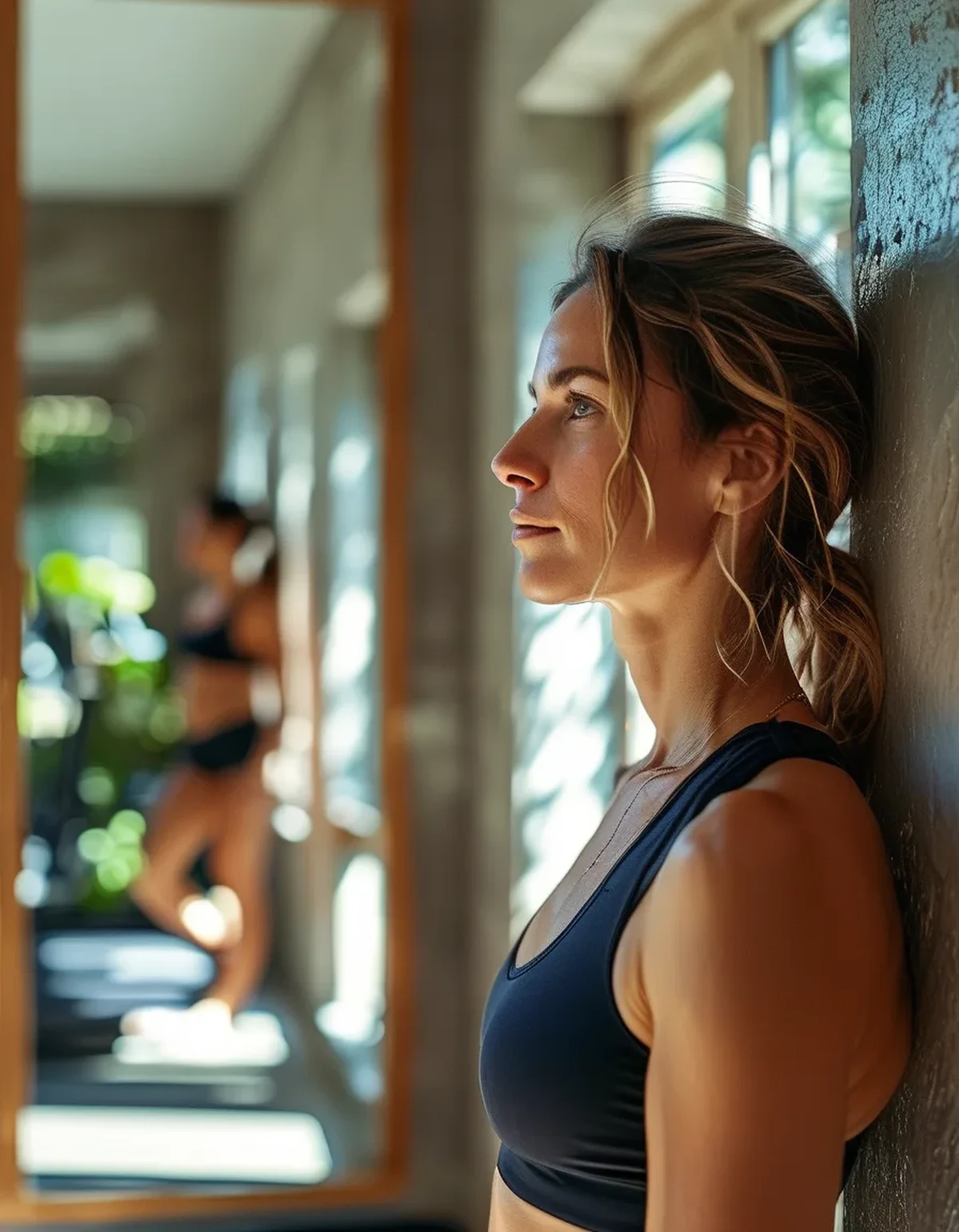
Why does a side mirror actively hurt your form?
Because looking at it requires a movement that the lift is supposed to prevent.
Under a loaded barbell or during a heavy squat, head position drives spinal position. Rotate your head to check a mirror on your left and you introduce cervical rotation, which propagates down into thoracic rotation, which changes how the load is distributed across the spine. You have added an asymmetric movement to a lift you are trying to keep symmetrical, and you did it precisely at the moment you were checking whether it was symmetrical.
The irony is exact: the act of looking makes the thing you are looking for wrong. And because the rotation happens as you glance, what you see in the mirror is not the position you were in a moment before.
There is a second problem. A side mirror gives you a sagittal view, which is genuinely the most informative angle for hinges, squats, and presses - it is exactly what a coach would want to see. But you cannot look at a side view without turning, so the information is unusable in real time. That is the core tension of mirror placement: the most useful angle is the one you cannot safely look at.
What a front mirror does and does not give you:
- Gives you: left-right symmetry, knee tracking, bar tilt, shoulder height, hip shift
- Does not give you: spinal position, hip hinge depth, bar path, forward lean, neck alignment
Roughly half the things people use mirrors for cannot be seen in a front mirror at all, which is why so many people report that their form looks fine in the mirror and wrong on video. The mirror was never showing the plane where the error lived.
What is the correct placement, specifically?
Four variables: wall, distance, height, and lighting.
Wall. Mount on the wall you naturally face during your main lifts. For most home setups that means the wall in front of the squat rack or the head of your mat. One large front mirror beats several small mirrors scattered around, because scattered mirrors invite glancing.
Distance. Stand at least 6 to 8 feet back. Closer than that and you cannot see your whole body without moving your eyes up and down, which changes head position. Distance also reduces the apparent distortion from any slight bow in the glass.
Height. The bottom edge should be 12 to 18 inches off the floor so your feet are visible - foot position and knee tracking are the two things a front mirror is genuinely good for, and cutting off the feet removes half of that. Total height of 60 to 68 inches covers most people standing and shows the top of the head with arms down. For overhead work you cannot cover the full range at any reasonable height, which is another argument for filming.
Lighting. Light from the front or above, never from behind you. Backlighting turns you into a silhouette and hides exactly the joint angles you were checking. A single overhead light in front of the mirror line is the simple solution; two side lights at 45 degrees is better if you also want to film.
Mounting. Gym mirrors are heavy. Wall-mount with proper anchors or use a purpose-made leaning mirror with a floor stop. A large mirror leaning against a wall in a room where weights are dropped is a genuine hazard - secure the top even on a leaning unit.
Safety glass matters. Look for tempered or film-backed mirrors in any space where anything can be dropped or racked. Standard mirror glass shatters into large sharp pieces.
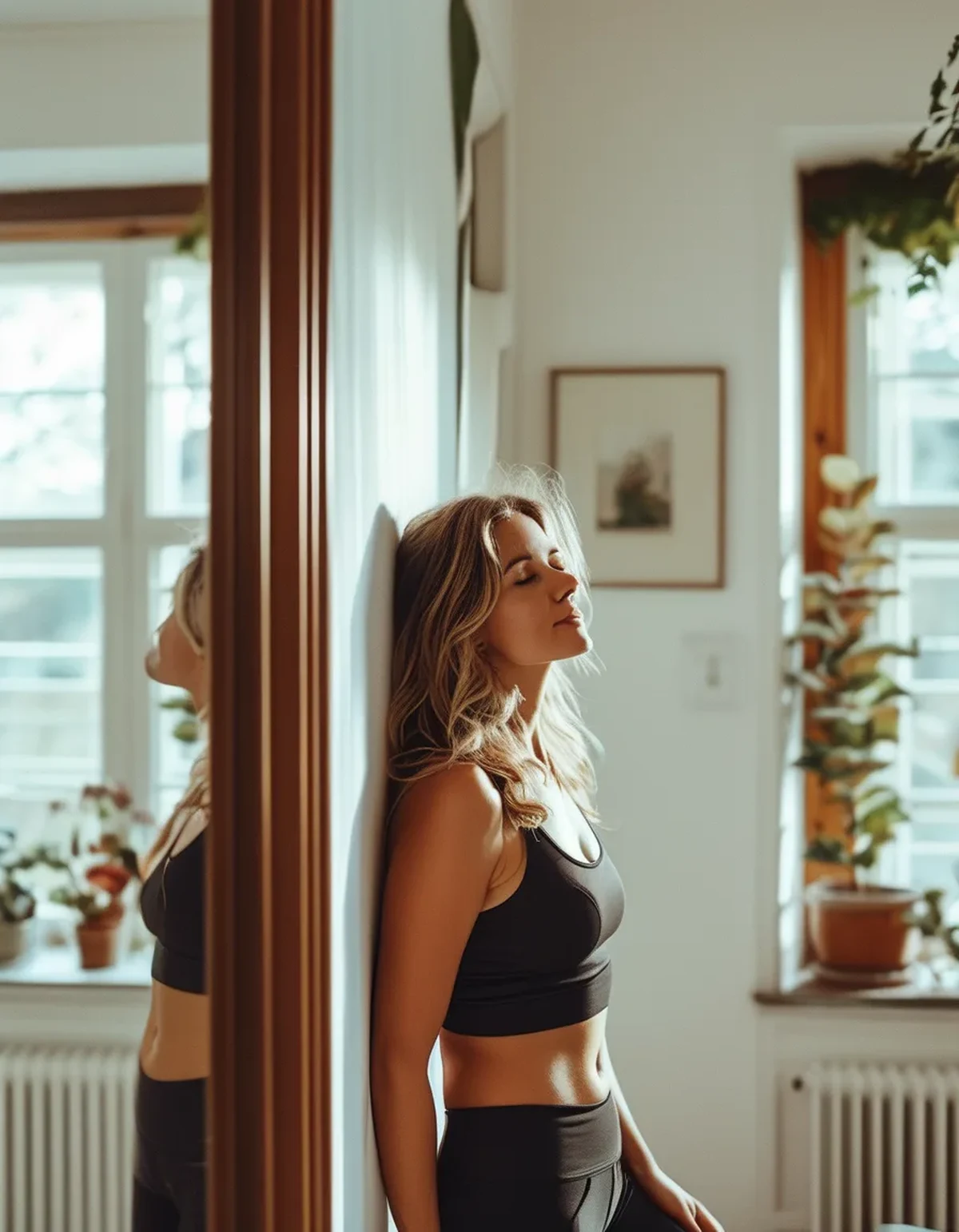
When should you use a mirror at all?
Less often than most people do, and for specific purposes.
Mirrors are useful for:
- Learning a new movement pattern, in the first few sessions, at light load, where real-time feedback speeds up the mapping between what a position feels like and what it looks like
- Symmetry checks - shoulder height, hip shift, bar tilt
- Isolation work where you can watch a single joint without moving your head, such as lateral raises or curls
- Mobility and stretching, where load is low and head position is unconstrained
Mirrors are unhelpful or harmful for:
- Heavy compound lifts, where head position must stay fixed
- Anything requiring a sagittal view - deadlift, hip hinge, squat depth, bar path
- Overhead work, where you cannot see the position without extending your neck
- Any lift where you are already at the limit of your attention
The bigger issue is proprioceptive dependence. Continuous visual feedback appears to reduce reliance on internal position sense. People who learn a movement exclusively in a mirror often perform it worse without one, which matters if you will ever lift somewhere else, on a platform, or in a competition. The practical middle ground is to use the mirror while learning and then deliberately remove it - face away, and check by feel, with video confirming afterwards.
Video is better than a mirror for almost every serious purpose. A phone on a small tripod at 45 degrees, filming three or four working sets, gives you the sagittal view, lets you watch in slow motion, shows the reps you cannot see while performing them, and creates a record you can compare across months. The one thing it does not give you is real-time correction, which is exactly what a mirror is for. Use each for its own job.
5 Mistakes People Make With Home Gym Mirrors
1. Putting it to the side because that is where the wall space is. This is the most common placement and the worst one. If the only available wall is to the side, you are better off skipping the mirror and filming instead.
2. Mounting it too high. A mirror starting at waist height shows you a torso. Foot placement and knee tracking are the highest-value things a mirror can show, and they are the first things cropped out.
3. Standing too close. Under six feet you cannot see your whole body without scanning your eyes, which moves your head. Depth of space matters more than mirror size.
4. Lighting from behind. A window behind you turns every check into a silhouette. Move the mirror or cover the window during training.
5. Treating the mirror as the assessment. The mirror shows one plane at one moment. It cannot show bar path, spinal position, or what happened on rep six. Film the sets that matter and review them afterwards.
FAQ: Home Gym Mirror Questions, Answered
How big should a home gym mirror be?
A panel around 48 inches wide by 60 to 68 inches tall covers most single-person setups. Width matters more than height for symmetry checks.
Is a leaning mirror safe in a gym?
Only with the top secured and a floor stop. Vibration from dropped weights walks a leaning mirror forward over time, which is a real hazard.
Should beginners use a mirror more or less?
More at first, for learning the pattern, then deliberately less. Building position sense without visual feedback is the goal and it needs practice without the mirror.
Can I use my phone screen as a mirror instead?
As a rough check, yes, and the delay in most camera preview modes is small. A propped phone at 45 degrees is more useful than a badly placed mirror.
Does mirror quality affect what I see?
Yes. Thin or poorly supported glass bows slightly and distorts proportions, which is why gym mirror photos look different from reality. Thicker glass mounted flat against a straight wall distorts least.
TL;DR:
- Mount the mirror on the wall you face, 6 to 8 feet away, with the bottom edge 12 to 18 inches off the floor so your feet show.
- A side mirror forces you to rotate your head under load, which introduces the exact asymmetry you were checking for.
- A front mirror shows symmetry, knee tracking, and bar tilt. It cannot show spinal position, hinge depth, or bar path.
- Light from the front or above. Backlighting hides every joint angle you care about.
- Use the mirror to learn a pattern, then train without it and use video to check.
If your only spare wall is to the side, buy a phone tripod instead of a mirror.
Keep Reading
This article is for general informational and styling purposes only. Fit, sizing, and product availability may vary.