Why You Look Different in the Gym Mirror Than at Home

Quick Answer: Gym mirrors and home mirrors disagree because of four physical variables, not your body: glass quality and thickness, mounting lean (a top-tilted mirror stretches and slims, a bottom-tilted one squashes), lighting direction (overhead gym light carves shadows and definition; flat home bathroom light erases them), and viewing distance. Add the psychological layer — you at the gym mid-pump versus you at home mid-morning — and the two reflections are genuinely different images of the same body. Neither is the truth; a photo in consistent conditions is the only referee worth trusting.
Every lifter has a favorite mirror and a nemesis mirror, and most quietly suspect the gym of installing flattering glass. The suspicion is not paranoid — mirror physics is real, installers are careless, and lighting does more for visible muscle tone than a month of training. Knowing the variables saves you from chasing changes that are actually architecture.

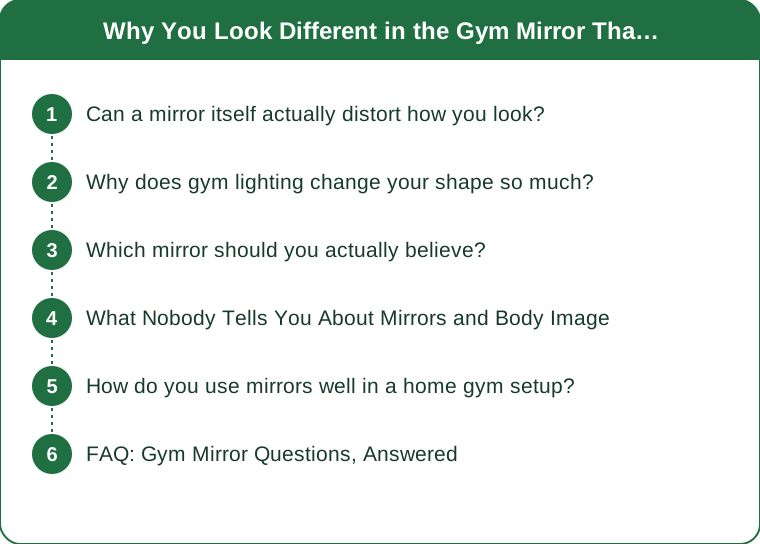
Can a mirror itself actually distort how you look?
Yes — cheaply made or badly hung glass measurably reshapes you.
Thickness is the first tell. Standard commercial mirrors are float glass around 4 to 6mm; thin builder-grade panels flex under their own weight once mounted on imperfect walls. A bow of a few millimeters across a full-length panel acts like a subtle funhouse curve — a concave lean slims, a convex bulge widens. Big wall-sized gym panels are heavy and usually flat; the sketchy ones are the tall cheap panels in apartment bedrooms and clothing-store fitting rooms.
Tilt is the bigger everyday culprit. A mirror leaned against a wall — the standard home setup — tilts its top away from you, elongating the reflection: legs read longer, bodies read leaner. It is the same reason fitting-room mirrors are so often accused of flattery; a few degrees of lean is invisible as a lean and very visible as a slimmer you. A mirror tilted toward you at the top does the opposite.
Wall flatness matters more than people think. The same panel screwed flush to a flat gym wall and glued to a wavy drywall section will disagree with each other.
The test costs nothing: stand square to the mirror and check a door frame or column in the reflection. Straight vertical lines mean honest glass; bowed or converging lines mean the mirror is editorializing — and every judgment made in it inherits the edit.
Why does gym lighting change your shape so much?
Because visible definition is mostly shadow, and lighting decides where shadows live.
Gyms light from above, often with strong directional fixtures. Overhead light rakes across the body, catching every surface change — shoulder caps highlight, the line down a quad shades, abdominal definition appears at settings the bathroom has never once produced. Photographers call it hard light, and it is the most muscle-flattering setup that exists, which is exactly why physique photos are shot under it.
Home bathroom lighting is the opposite instrument: diffuse, often frontal, frequently warm. Front-on light fills shadows in — smoothing skin, yes, but also flattening the same definition the gym revealed. Neither light is lying; they are answering different questions. The gym asks “where are your muscles?” and the bathroom asks “where is your skin?”
There is also a state-of-body confound riding along: the gym reflection is you mid-session — blood-flushed muscles temporarily fuller, posture organized, core braced — while the home reflection is resting you, often post-meal, unpumped and unbraced. The pump alone changes visible arm and shoulder size for an hour or two after training.
So the flattering-gym-mirror conspiracy mostly dissolves into physics plus physiology: honest big glass, hard top light, and a pumped body versus leaning thin glass, flat light, and a resting one. Which is also why neither one can be your progress judge.
Which mirror should you actually believe?
Neither — believe a controlled photo, and use each mirror for what it is good at.
Progress judged by ambient mirrors inherits every variable above plus memory’s editing. The referee that removes them is a fixed-condition photo protocol: same spot, same time of day, same artificial light (window light changes by season), same phone position — propped, not handheld — same three poses, roughly every two weeks. Front, side, back; relaxed, not flexed. Two minutes, filed in one album, compared monthly. Bodies change slower than moods; the album shows the trend the mirrors keep repainting.
Then assign the mirrors jobs they can do:
The gym mirror is a form tool. Bar path, squat depth, knee tracking, row symmetry — that is what wall-sized flat glass is for, and it is genuinely good at it.
The home mirror is an outfit tool. Fit checks — whether the waistband sits right, whether new leggings pass the sit-and-squat opacity test before their first public outing — need only a consistent mirror, not an honest-to-the-millimeter one, because you are comparing garments against each other in the same glass.
And if the home mirror leans, fix it: mount it flush or shim the bottom until a reflected door frame runs straight. A five-minute correction ends the daily double-take between bedroom-you and everywhere-else-you.

What Nobody Tells You About Mirrors and Body Image
You cannot see yourself neutrally in any glass. The reflection arrives pre-filtered by attention: people zero in on the features they monitor, and mood measurably shifts perceived size — the same person literally sees a different body on an anxious day than a confident one. That is not a metaphor; body-image research finds perception tracking mood while the body itself holds still. The mirror is a screen, and some of what plays on it is projection.
Mirror-checking frequency follows the same curve as any checking behavior: past a point, more checks mean less accuracy and more anxiety. If gym mirrors pull your attention off the set itself, training briefly in a mirror-free corner or facing away is not avoidance — athletes do it deliberately to shift focus from appearance to performance, and the workout usually improves.
The angle-of-approach effect is sneakier than the mirrors themselves: catching your reflection unposed — walking past a shop window, sitting in a car — compares terribly against the straightened, squared-up posture you unconsciously adopt the instant you face a mirror on purpose. The shop window is not the truth either; it is just the only version you never prepare for.
And the one that fixes the most distress per sentence: everyone else is watching themselves. The gym mirror wall that feels like a stage is fifty people running fifty private evaluations, none of which are about you. The glass is crowded with self-portraits only.
How do you use mirrors well in a home gym setup?
If you are hanging your own glass, get in one order what gyms get by accident.
Buy thickness before size. A 5 to 6mm panel resists the flex that curves cheap glass; one honest medium panel beats a wall of thin ones. Glassless acrylic and stick-on tiles are fine for presence and terrible for accuracy — expect a gentle funhouse from every seam and call it decor.
Mount flush and verify. Screwed to a flat wall at true vertical, then run the door-frame test from your usual standing spot. Shim until reflected verticals run straight. This is the entire difference between a mirror you can trust for form work and one that flatters or insults at random.
Light from above and slightly in front, not from behind you (silhouette) or head-on (flatland). One decent ceiling fixture or an angled shop light recreates the gym’s definition-friendly rake for almost nothing.
Place it for the work: far enough to see full squat depth — around 6 to 8 feet — and oriented so your main lifts are side-on, where depth, hinge angle, and bar path actually live. Front-on flatters; side-on informs.
Done once, the home mirror stops disagreeing with the gym mirror in kind and starts disagreeing only in wardrobe — a yoga pants fit check in honest glass under decent light is, quietly, the most practical luxury a home gym owns.
FAQ: Gym Mirror Questions, Answered
Do gyms intentionally install flattering mirrors?
Mostly no — commercial gyms buy thick flat panels because they survive impacts, and flat panels are honest by nature. The flattery people notice is almost always the lighting doing definition work plus the post-set pump. Boutique studios and clothing retailers are where deliberate tilt and warm bulbs earn their reputation.
Why do I look better at the gym but worse in gym selfies?
The mirror gives you hard top light on a pumped body viewed at flattering distance; the phone adds lens distortion up close, a flash that flattens, and an unposed angle. Photograph from further back at chest height under the same overhead light and the gap narrows sharply.
My two home mirrors disagree with each other — which is right?
Run the vertical-line test on both from your normal viewing spot: the one where door frames stay straight is telling the truth about shape. If both pass, the difference is lighting and distance, and both are right about different things.
Is there a way to see myself accurately without any mirror?
The fixed-condition photo protocol is the closest practical instrument — consistent light, distance, and pose, compared across weeks. For single moments, a timer photo from 8 to 10 feet at chest height distorts least. Accuracy in a single glance does not really exist; consistency across many is what you can have.
TL;DR:
- Mirrors disagree for physical reasons: glass thickness and flex, mounting tilt (top-away slims, top-toward squashes), lighting direction, and distance.
- Gym conditions — flat heavy glass, hard overhead light, a pumped body — reveal definition; home conditions flatten it. Neither is the lie; neither is the referee.
- Judge progress only by fixed-condition photos every two weeks; use gym mirrors for form, home mirrors for outfit and opacity checks.
- Fix a leaning home mirror with the reflected-door-frame test, and remember mood repaints the reflection more than any glass does.
Run the vertical-line test on your most-consulted mirror today. If the door frame bows, you have been arguing with architecture — and the argument ends with a shim.
See It in Motion
Seen here: High Waist Yoga Leggings with Side Pockets — shop it on bubblelime.com
Keep Reading
This article is for general informational and styling purposes only. Fit, sizing, and product availability may vary.